Showing posts with label Culture. Show all posts

Saturday, January 16, 2016

The Iowa Caucus Approacheth!

Since the beginning, this blog has focused on the numbers more than the quality of the candidates. Hopefully, that can begin to change as hordes of candidates drop out of the race.

For the democrats, the nature of the coming battle is essentially decided.There is the status quo candidate in Hillary Clinton and the radical left candidate in Bernie Sanders. Personally, I have despised Sanders since he played pussy to the BLM protesters back in August. However, I am glad that he is on stage because I have long felt that the hard left of the Democratic Party has been ignored.

Both parties today are really amalgams of groups which have little in common. Clinton represents the status quo party but Sanders represents the significant segment of society that thinks that America is long overdue for socialist reforms. In fact, I have a crush on him simply because some of what he says resembles my dreams when I was a young democrat who still believed that the party represented blue-collar workers and their families. However, walking away from pond scum that should have been sent packing at that meeting in August soured whatever lingering sympathy I had for him. I am not interested in an America in which rude BLM protesters have any say.

On the republican side, the equation is only starting to become clear. While some are already calling for a Trump fait accompli, I am more cautious and, as always, remember the power of money, of which Bush has a lot.

Nevertheless, things have become more clear. At the very least, that fucking zombie candidate George Pataki has dropped out. His continuing candidacy was a sign that the republican party was still playing around and not getting serious about the election. The number of real republican candidates can now be counted on one hand:


  • Donald Trump. Liberals long discounted the seriousness of his campaign because they are unable to imagine a world in which people do not agree with their views on some visceral level. In the minds of liberals, conservatives would agree with them if only they would engage in dialogue. Trump's ongoing popularity may finally be beginning to show libs that some Americans are simply out to get them, with no apologies.
  • Ted Cruz. Long seen as an unofficial ally of Trump's, Cruz is starting to distinguish himself from the billionaire by courting evangelicals. He is increasingly looking like the hard-right Christian candidate, though his eligibility to be POTUS is even more in question than Obama's.
  • Ben Carson. His star is definitely falling and I do him a favor just including him on this list. The era of white-guilt voting is over. Carson will not be the GOP candidate unless somebody literally kills three or four other candidates.
  • Marco Rubio. The press tried hard to give the candidacy to this young Latino months ago but his appeal has waned. He is not the Christian candidate and he is not the white-anger candidate. In the GOP today, this means - no votes for you!
  • Chris Christie. I am not a fan but but I commend him for sticking it out, fighting his way up from the kiddie table debates to be included in the final selection. He actually has more merit than many candidates in that he has held executive office and acted as a national figure for years now.

Notice that I forgot Jeb Bush? Okay, I admit that this was intentional. I do not want another member of the ruling Clinton-Bush-Obama dynasty to win but I actually think that his chances are decent. Money talks and Bush can hang in there for months to come. It does not matter if he loses Iowa and New Hampshire. He has the cash to wait in the wings and exploit any chaos in the electoral process to his own advantage.

Sunday, November 15, 2015

The Democratic Debate: Tag Teaming Hillary Clinton

The Democratic debate rolled around again and it was a little more interesting this time because there were only three candidates on stage, the other likely contenders having resigned from the race. While this potentially created the opportunity to just increase the focus on the two ongoing leaders, Clinton and Sanders, it probably provided much more attention for Martin O'Malley, who was practically invisible prior to last night.

Diverse They Ain't

I have mentioned before that the Republican field of candidates is much more diverse than the Democrats' round up of the usual suspects this time around. A picture of the three contenders looks more like a klan rally than anything else.

OK, maybe that's a little unfair. After all, these three are only "white" in the very loose definition of race that exists today. Sanders is, after all, Jewish and O'Malley is Irish. The Irish were not really considered white even a century ago. Remember who was building the railroads alongside blacks and the Chinese in the 19th century?

Nevertheless, the GOP does come off with more points for diversity this time around. They've got multiple hispanics, a very viable black candidate and a woman.

How They Did

Hillary Clinton

  • The other Democrats finally took off the gloves and lashed out at Hillary. Many analysts have stated previously that Hillary was going to run away with this nomination unless somebody manned up and started criticizing her. 
  • Both Sanders and O'Malley were able to take the high ground diplomatically because neither of them can be tied to voting for the Middle East debacle. Clinton joined with other Democrats to vote for the controversial invasion of Iraq which undeniably led to the present chaos in that region  and in Europe.
  • They were also not afraid to bring up her ties to Wall Street. However, most seem to agree that her defense was adequate. Still, it was a defense and it shows that Clinton is no longer untouchable. She is going to have to defend herself if she is going to get this nomination.
Bernie Sanders


  • The biggest advance for Sanders came simply with his willingness to attack Clinton's record. Providing this contrast will undoubtedly improve his long-range chances of taking an electoral lead. 
  • He failed to utilize the email issue, though, and that is perhaps Clinton's greatest weakness. This sort of cooperation among the candidates stinks and leads me to wonder if the race isn't simply an opportunity for Clinton to air out a lot of issues publicly and make voters bored of them before her cakewalk to the national election.
  • Sanders also did not look good when Clinton ridiculed his idea of free college for everybody. She pointed out that this policy would use taxpayer money to pay for Donald Trump's kids to go to school. Hopefully that is the end of that piece of idiocy,
Martin O'Malley
  • Martin O'Malley wins big simply for having a lot of face time with the public. This was a great opportunity for voters to hear an option to Sanders and Clinton. He presents a major threat to these other two simply by showing up and potentially leeching off undecided or less fervent voters. 
  • He also joined in the attacks on Clinton. He called her a flip-flopper on gun control.
  • In particular, he benefits by having had nothing to do with her war record and her participation in regime changes, such as that in Libya which has obviously destabilized the country.

I am not a Democrat but I can say that the democratic race is finally starting to look exciting. It seemed like Clinton was locking up the race when Sanders asked everyone to ignore her email dilemma. She may still run away with this one but there is at least the appearance of a real race at the moment. That will probably improve the ratings and, after all, that is all American culture really has any more: Facebook likes and Twitter hashtags.

Monday, October 26, 2015

ISIS and Liberals: Working Toward the Same Ends

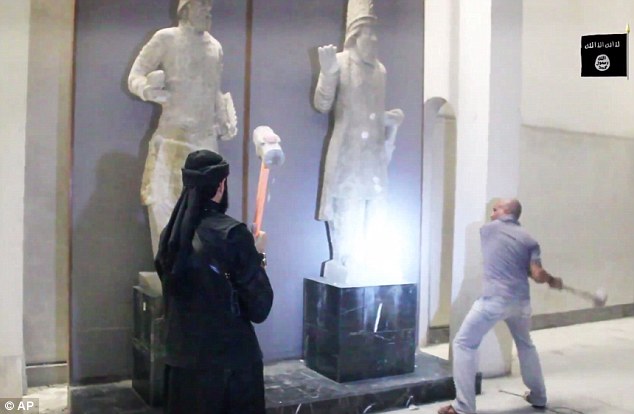
Hardly a day goes by that the news does not contain a glib reference to ISIS destroying some ancient monument or some other piece of our ancient history. This week, they managed to combine their two favorite activities, grisly executions and destruction of human cultural heritage, into one when they blew up three prisoners by tying them to historic Palmyran columns and just exploding everything all at once.

When I was younger, this might have gotten much more attention. Today, not so much. This event does not concern the modern American because he is already inured to human and historical destruction. You do not need to look very long at the comment section of any such story to see the ignorant screeds of today's liberals vilifying the killers as religious even as they ignore or even applaud the destruction of something from our common history (or ignore the destruction of a million fetuses every year in our abortion clinics).

Today's college kids secretly love this shit: History, after all, is sexist and racist.


One disturbing trait in the typical liberal today, even those who have allegedly been educated in our most respected institutions of higher learning, is the almost entire lack of any regard for the past. A columnist somewhere wrote that today's youth are basically technopeasants. They are enamored of their technology and think themselves very advanced but they basically have no knowledge of anything outside their computers and their phones. They disregard history (and most think that math is a school subject too hard to take seriously). As for great historic figures such as Agamemnon or Julius Caesar, they were probably sexists and racists (though any juicy tidbits about the pederasty of the Greeks and Romans are always enjoyed by this crowd.)

I briefly taught high school classes after many years as a Montessori teacher in the elementary grades. It sickly amused me one day when my students disparaged historical figures about whom we were reading because they were so backward and "now we're more educated and stuff." My head nearly spun. The children in front of me were barely literate and knew next to nothing about anything outside their phones and their social media accounts. Nineteenth century farmers could have told them more about the world around them in an hour than they will ever learn in life.

Political correctness has erased critical thinking from our natural skill sets. Young people are finding it more and more difficult to integrate into the working world because it is a composite of cold, hard facts. It does not matter how you feel about showing up to work on time or what your perception of your boss is.

This is not to say that you should not have concerns about the way that your work environment is arranged. What handicaps young people is the idea that their feelings are real things. They are not. Justice is a real thing. An employer may be unjust to his employees and this is a real concern. That he is simply mean is...meaningless.

Today's young, liberal youth coming out of school would be much better prepared for the world if they had ever had to take seriously the lessons of our past. Greek sculpture, Byzantine painting and medieval Catholic art should be taken seriously not because you necessarily believe in their gods but because they are beautiful and meaningful parts of our history. You do not have to believe that the world is 6,000 years old to derive meaning from the story of Noah in the opening chapters of the Old Testament or accept Jesus as your Savior to appreciate the concept of mercy demonstrated in the Gospel According to Luke.

Unfortunately, these texts, as well as many of the great Greek philosophers and Roman orators, are practically non-existent for school children today. Publicly deemed too difficult (and secretly reviled by the PC police as sexist, racist, genderist and whatever the fuck else they can think of), these texts are increasingly hard to find in modern classrooms.

The PC police are no different than the extremists in the Middle East. They see themes in the work of the ancients that do not come to the same conclusions as they have in their multi-cultural religion. Like the ancient Christians whom they ignorantly and mistakenly accuse of destroying ancient works (when, in fact, they preserved those works for us), the antifas and the PC police eagerly erase or ignore cultural jewels from our past.

Politically correct censorship is just soft Jihad.

Sunday, October 4, 2015

Two Conflicting Sentiments in American Politics

A few years ago, something occurred during a biology class that I was taking which illuminated the modern political and social landscape of America. With just one comment made by a classmate, it was as if someone just turned on the light in a dark room and, suddenly, everything was clear. I knew right where I and everybody else was in that room with regard to political ideals.

A Biology Lesson

I own much of this illumination to the identities of the people involved. I am a middle-aged man who, at the time, was taking a pre-requisite course to get into nursing school ( I graduated a few months ago). The conversation which I was witnessing took place between my instructor, perhaps 5-10 years younger than me, and a young girl taking the class. She was probably 20 years old.

The professor was explaining the nucleotides that compose the very basic elements of our genetic structure. He remarked that errors in the layouts of these nucleotides were responsible for many diseases. In fact, he said, it was known that UVA radiation could cause thymine nucleotides to bind into units called thymine dimers. These mutations were the primary cause of skin cancer.

Then he said that it always pained him to hear about people using tanning beds. They were just increasing the chances that their thymine would mutate and cause cancer.

The young girl in the class spoke up. "That's awful. If I were president, I would outlaw those places."

The professor, God bless him, replied that there was something called the US Constitution and we were all still free to make decisions for ourselves, even if those decisions were not good for us.

The girl later went on to comment that she just didn't feel safe in a country where it was permitted to endanger yourself. As I recall, the professor turned us back to the lesson and the moment was left behind, only to live in my memory.

Safety versus Freedom

It occurred to me, as I tried to comprehend why I found the girl's comments so repulsive, that she represented one side of a dichotomy in American mindsets. It also revealed to me an explanation for the differences between the general nature of American and European political divides.

This country was founded and colonized by a wide variety of people. The Puritans were not the only ones to come over from the Old World. Yet those early Americans shared one quality or drive in life. They wanted to be free to live as they pleased. Their great common desire was to be left alone to pursue their destinies. They wanted to be free to create their own worlds and manage their own protection from the elements and from their fellow human beings.

Even later immigrants, on whom descendants of the earliest Americans looked down, shared a similar drive. They were escaping poverty or limitations of some sort in Europe in order to come here and find their own way.

In the early 20th century, the much-reviled Southern European immigrants were not coming to America to be on the dole. There was no welfare system. They fully expected to be left to their own devices when they hit the shore. As long as they had a chance to fight for their own prosperity in a land that seemed to have endless real estate and resources, they were content with the opportunity.

There is another social desire active in the world. This is the desire to be safe, to be protected. The semi-mythical contract that occurred between post-Roman Empire Europeans and the feudal knights demonstrates the centrality of this desire in the human psyche.

Allegedly, the feudal transformation of Europe occurred when villages of common people agreed to provide economic support for soldiers, typically led by the horsemen we would call knights now. in exchange for protection from the increasingly chaotic environment left as Rome's influence ebbed in Europe. I doubt any such exchange occurred as cleanly as that but I am also sure that there is a kernel of truth in it all. With banditry on the rise and the roads becoming home to crime rather than commerce, I am sure many people gave up their freedom to be safe.

Sound familiar?

As time passed, the boundlessness of US resources became somewhat less boundless. While this nation still retains an immense amount of open land, times changed during the 20th century. Urbanization increased, especially after the world wars. We became a people primarily living in cities, cities in which we were protected by police forces rather than a village posse or our own arms. Also, the generations that had come here seeking freedom passed away and were replaced by descendants who did not necessarily share their desire for freedom.

Instead, they wanted what those medieval Europeans wanted: protection from crime. These new Americans were increasingly less armed than their forefathers. They wanted to enjoy urban prosperity, learn new trades and even go to school to study the liberal arts rather than forge a new life in the wilderness or build a business from scratch. In order to do these things, they wanted government to take on the job of keeping them safe while they pursued these new goals.

They were willing to give up certain things, such as the right to bear arms, in order to create a protected environment in which they could pursue these goals. In short, they valued safety more than freedom.

That doesn't sound so awful. However, I think that this new desire for safety rather than freedom has again morphed with the latest generation into something that does, in fact, sicken me,

That girl in my biology class did not simply want to make a calculated decision to sacrifice a specific freedom in exchange for another social good. She wanted to live in an environment in which she no longer had the ability to make bad choices at all. Rather, she wanted someone else making those decisions for her. In essence, she wanted to be a perpetual child and she wanted her political leaders to act as pseudo-parents. She wanted Barack Obama to be her father and simply refuse to permit unsafe things in her home environment.

Women's Suffrage and the Infantilization of America

Something else occurred in America during this last century which I believe had a huge impact on its political and social transformation. Women became full-fledged citizens with the right to vote.

Now, the move to give women the vote was ostensibly done by forces which might be characterized as conservative today. There had long been a liberal movement to give women the vote in the Anglo Saxon world. However, the granting of voting rights was really done in Western states in order to hurry the process ending in statehood. These territories suddenly had many more voters and possessed more "statelike" populations in terms of size.

I posit that this had a big effect on the increasing concern with safety in this country. Prior to this, I am sure that most American men wanted, more than anything else, the space and opportunity to live out their lives.

Women, though, come into the world with completely different mindsets. Contrary to pseudo-lesbian feminist beliefs, women are born with family on their minds. I am not one of those who believes that women are naturally more nurturing or more gentle than men. Anyone who has been married knows that this is simply not true,

However, by force of millions of years of biology, women do tend to think in terms of family and children. They are more naturally comfortable with children. To their credit, we probably owe much of our rise from the animal kingdom to women's incessant chattering with children, which helped develop those children's minds with regard to language.

I think that this sudden preponderance of women in the voting bloc (they are over 50% of the population) explains much of the recent past politically.

How much of our political conversation, especially since the onset of the Cold War, has been dedicated to the cause of protection? We wanted to be protected from the Nazis. the Soviets, the terrorists and now,increasingly, people who say "mean" things. Women have been all too happy to throw out freedom of speech in order to prevent feelings from being hurt. This reminds me of a mother forbidding her children to broach certain topics just because she doesn't want to deal with another familial eruption.

Of course, it is not just women who engage in this kind of thinking. Men do it, too. That is, they think this way until they become men. Boy children want to be protected from harm as much as girl children until they begin to develop. Then they begin to fight, explore, seek their own way in the world,

I think an additional phenomenon explaining this conflict in American politics is not just the addition of women to the voting bloc but also the pacification, feminization and infantilization of many men. Or, rather, it is that many men never really develop into men but remain in a stage of early adolescence which leaves them all too ready to seek safety rather than freedom in life.

Other Groups in America and in Europe

This thinking has helped me to understand why conservatives in Europe often have distinctly different views on social and economic issues when compared to American conservatives. Many conservatives in Europe consider a certain amount of socialism to be natural and even desirable.

This makes sense when you remember that they are the descendants of those peasants who chose to stay in the Old World and embraced the idea of being protected by government. The democratic governments have simply replaced the knights and nobility of centuries past.

It also explains to me why other groups in American politics never seem to embrace "American ideals". Africans did not immigrate to this country seeking freedom to live as they please. They were abducted, sold and transported here against their will. It makes sense that they do not have any genetic impulse to seek freedom over safety since their ancestors had no desire to cross the ocean to be here in the first place.

How this applies to Latino immigrants might be a good topic for another essay. This article is already too long.

However, in closing, I think that this concept helps to explain a lot that is going on in American politics now and even applies to the ascendancy of Donald Trump. Again, this is a topic for another article.

Monday, September 28, 2015

Election 2016: What Is Wrong with This Country?

The answer to this question depends on who you ask. More than one social commentator has spoken about the growing divide between Americans with regard to political views. Even someone like me, just in his 40s, can remember a time when liberals and conservatives found common ground on numerous issues. More importantly, we all went to social gatherings and managed to get along in public. As Election 2016 nears, the issues that divide us became ever more clear.

Now, the tone has changed significantly. I was saddened to see a Facebook friend proudly proclaim that she would immediately block anyone who ever posted anything that she felt was sexist. There would be no discussion and no appeal. The person would simply be gone. Leaving aside all the comments I could make about the hubris of actually thinking that banning people from your friend list was some sort of significant threat, I thought how awful this person must be inside to be so eager to cut off relationships based on differing perceptions.

But that is increasingly the way that it is in this country. I find that it is impossible to have a distinct opinion about matters of race, sex, gender etc. without suffering immediate insult.

If I state that I do not think that Bruce Jenner is a woman, and point out simple scientific facts about trillions of cells in his body possessing the Y-chromosome, I should not expect a calm rejoinder about different views of what composes one's gender. Instead, I should be prepared to be outed in violent verbal fashion as a sexist, transphobe or whatever the fuck they call it. I can also expect to lose a friendship, apparently.

If I suggest that we are a country of immigrants and share a great deal in common with Latin Americans when compared to other immigrant waves, I can expect an energetic tirade about Mexican cartels and Latin American welfare queens and remittance schemes.

The distinct answers to this question, then, are really the answer themselves. The problem is this great divide in the perception of present reality. Each side sees completely different things wrong with the country.

What Liberals Think Is Wrong with This Country

When I was young, I definitely thought of myself as a liberal. As a liberal, I had a distinct set of concerns. They were mostly focused on working families and their economic viability. I was afraid that big business would not take care of these people without government interference to ensure their protection and their proper compensation for their work.

One motivation for leaving the Democratic party, to which I briefly belonged in the early 1990s, was the changing focus of the democrats. I do not know any liberals now who really seem to care about poor white men living in trailers and trying to support families. Instead, those men are seen increasingly as the problem by liberals. These uneducated men are likely racist and sexist.

Instead, liberal concerns seem to have turned toward identity politics. It does not seem to matter if you are earning a wage to support a family. Indeed, I believe that many liberals see the family as a unit of oppression. It appears to me that liberals envision a future of individuals who are freed from any kind of bonds on their identities: neither race nor gender nor religion will define a person.

Indeed, religion is an immensely important sub-topic in this discussion. When I was that young man so long ago, both liberals and conservatives went to church on Sunday. If anything, this issue divides liberals and conservatives more distinctly than any other. Liberals, by and large, do not go to church or they go to churches which speak more often about social issues than they do about theological issues.

While some liberals will hold back when discussing religion when they are around people whom they know to be adherents of one faith or another, Internet forums make it quite obvious that they truly despise religion and consider believers to be idiots in whom their can be no sort of trust with regard to the arch-important matters of sexism, racism etc.

What Conservatives Think Is Wrong with This Country

If you are having this conversation with a group of people and suddenly switch from a liberal to a conservative reply, you might think that you are asking questions about two different countries.

To conservatives heading into Election 2016, it appears that liberals are living in some sort of illusory world. This perception is best described by the recent Bruce Jenner event in which he altered his body surgically and declared himself to be a woman. The press immediately began using the feminine pronoun to describe Jenner. It makes conservatives think that liberals use some kind of magical thinking: whatever you think to be true is true, apparently. Conservatives begin to ask, can you make 2+2=5 in that world?

Conservatives see a black man in the presidency and assume that racism is essentially over and everyone can move on. Obviously, race did not keep a black man from reaching the highest office, so how can racism still be impacting black lives?

Conservatives fear the increasing atomization of the family. They see it as responsible for crime and even disease in the long run. Generally, they see the nuclear family as ideal.

You would have to dig deep to find a conservative who did not believe in the essential equality of the races, at least with regard to rights. However, conservatives tend to guard their opinions about the natural abilities and inclinations of each race. Decades ago, it was common for people to speak about the goals and inclinations of each race in distinct ways. Now that this is forbidden, conservatives may pay lip service to the idea of absolute equality but carefully reveal dissidence in guarded conversations.

Conservatives are also still concerned about economic issues form the cold war. They are fearful of a perceived rising socialist threat in the advance of the welfare state.

Immigration has become the biggest conservative concern, possibly because it naturally includes so many of the issues which divide liberals and conservatives. Here you find race and economics together.

Conservatives, in general, treasure the European history which they inherited and the influence of European immigrants on the country in the past. The waves of Latin American immigration which have battered the shores of this country in recent decades concern them greatly for two reasons: they see an eroding of the cultural foundations of the country and they are afraid of the economic impact of so many people living off other people's taxes.

Exceptions to the Rule

There are liberals who are in favor of greater immigration restrictions and conservatives who do not believe in God.

Certainly, the American political landscape is and always has been somewhat kaleidoscopic. My point is that it is much less so now than it was in the previous decades. Reading history, though, I can see that this concentration or crystallization of political viewpoints has happened before. Unfortunately, those periods always did great damage to the country in one way or another.

What Do I Think Is Wrong with This Country?

Most liberals that I know would definitely call me a sexist and a racist, though I am married to a Latin American woman and have experience raising a child in the home while my wife was the breadwinner. That is one of the reasons that I am not a liberal. In my opinion, they do in fact live in an imaginary world in which they can change reality with magical thinking.

Most conservatives would call me a liberal. I speak Spanish and have spent years working as a volunteer to help undocumented workers survive in this country. I like the free market but I have no problem with putting a wrecking ball to the whole health care industry and making government health insurance available to all citizens. I would definitely soak the rich by increasing their taxes.

So what do I think is wrong? The biggest problem is the division of the country into two camps. In the end, it may go back to the whole religion issue. Once liberals stopped going to church, we lost a common ground for meeting. Now liberal ideas were for the most part, cooked up outside the churches and those who remained inside the church walls began to strengthen the defenses.

We are already at war, in a sense. We just haven't started killing anybody. I certainly do not know the best way to resolve this growing divide. I am afraid that the only answer will come from the intensification of the conflict. If you look back at the history of the Civil War, you can see how the country simply came to the point where the only answer was bloodshed. People lost the ability to discuss the issues anymore.

I have good reason for thinking that it will not come to actual physical conflict in the future. I think that our individual lives are so free from the usual concerns of the past that we will not generate the motivation to go to war over these issues. For instance, everyone has more than enough to eat and a secure place to live. It is difficult to work up the ferocity required for war when you are physically comfortable.

But events can always take strange turns. You could have made the case, in the prosperous American colonies of 1770, that revolution against England was an absurd idea. Yet it happened. I hope, for the sake of my children, that we find a way to avoid conflict both before and after Election 2016 while actually working on real resolutions to our differences.

Wednesday, September 23, 2015

Who Is Marco Rubio?

After the second GOP debate, three top candidates were reconfirmed in their positions: Donald Trump, Carly Fiorina and Ben Carson. An additional member of the pack stepped into the foreground: Marco Rubio.

Some Biographical Data

Marco Rubio is one of the younger republicans running for national office this year. As of this writing, he is just 44 years old. If elected, he would be one of the youngest men to ever hold the highest office in the land.

Youth is not the only thing that distinguishes Rubio from past and present GOP candidates. He is a Cuban-American from Florida, one of three serving in the US Senate. His youth and ethnicity single him out at a time when liberals are more likely than ever to depict the Republican Party as a party of old, white men.

Furthermore, Rubio is a Roman Catholic. Only one Roman Catholic, the democrat John Kennedy, has ever served as US President, though the US population is more than 20% Catholic.

Political Background

Marco Rubio won his first election in 1999, when he narrowly defeated an opponent for the Florida State House of Representatives. In just three years, he became the Majority leader in that representative body. By 2009 he was ready for bigger things and ran for the US Senate seat that had been opened by resignation. He defeated the governor of that state, Charlie Crist, in that election.

As junior Senator from Florida, Rubio has represented ideas that have become fairly typical for Republicans today. He won his seat with strong Tea Party support. He has since distinguished himself somewhat from that political group with his stance on immigration reform (rather than enforcement) and his call for strengthening the military.

He takes a strong anti-abortion stance and received a B+ from the NRA on the issue of gun control. He is less republican on climate change, essentially taking an agnostic stance.

It remains to be seen whether Rubio will have the organization behind him to manage this sudden limelight. However, if his past is any indicator, he has been aiming for greater things since the very beginning.

Thursday, September 3, 2015

Who Is Ben Carson?

Donald Trump is not the only unlikely contender for the Republican Presidential nomination this year. Many Washington insiders have tried to make the traditional and now-to-be-expected poses as outsiders this year, but more than one candidate appears to be genuinely fresh to the American election spectacle. Among these candidates is Ben Carson.

Ben Carson's Background

Ben Carson's unusual background as a neurosurgeon, now retired, is actually of great assistance to him in the public eye. Even in an age increasingly burdened by health care regulations and outrageous costs, doctors still retain a noble character in public opinion. The moderate amount of fame acquired by Dr. Carson during his career (he is known for performing the first successful separation of twins conjoined at the head in 1987) also lends him an air of daring intelligence and skill.

Ben Carson's Politics

Carson has done much more in life outside of doctoring. He had taught at the University level and written several books. However, this is his first foray into politics. He gave a moving and much-remembered speech at the 2013 National Prayer breakfast.


When the political question was put to him in the wake of sudden public recognition, Carson denied being a member of either major political party in the US. However, in late 2014, he officially joined the GOP. He was quickly noted for his quiet, cerebral approach to many questions.

His views are staunchly conservative in many ways. He is adamantly against abortion and the abortion industry. He is a practicing Christian, raised in the Seventh-Day Adventist faith but attending a variety of churches of different Protestant denominations.He has stated publicly that marriage is only between a man and a woman. Other views of his are generally within the conservative boundaries.


The Elephant in the Room Ain't Pink

While virtually no one in this PC age is willing to discuss the matter, Carson's race provides him with unique advantages and disadvantages.

The good doctor is an African-American republican and that makes him stand out from the rest of the pack. Like Jeb Bush, he is well-prepared to counter and/or defuse the race car that Democrats can be otherwise expected to play in the General Election. He is not an old, white man who can be so easily insinuated to be trying to drag the country "back into the Stone Age." While I would not expect the Democrats to give him a pass when it comes down to fighting for power in the big battle next summer and fall, nevertheless they will feel compelled to pull their punches due to the color of his skin.

However, race may also impede his rise to the nomination. I am not a liberal and I do not leap to accuse Republicans of racism. However, I do not think that any thoughtful person can deny that the Republican party is much more of a white man's party than it is anything else. The simple fact is that Carson does not look like most of the people that he needs to vote for him. This is a barrier, pure and simple.

This very same barrier has been breached in recent history, though, with the nomination and subsequent election of Barack Obama. Dr. Carson has recently tied Donald Trump in republican polls so the outlook is improving for his chances at ultimate victory.

Wednesday, September 2, 2015

What's Wrong with Jeb Bush?

Exactly what is wrong with Jeb Bush? He is doing pretty poorly against two outsiders yet he could easily have been seen as the crown prince of the GOP given his heritage and background. The answer to the question depends on which party opines on the matter. The GOP answer is really the most important right now but it is always useful to see infighting through an outsider's eyes.

Democrats See Jeb Bush and Think...
Liberal boogeymen - Woohoo! Let's start a war and revoke abortion rights!

Without question, most libs look at Jeb and see George W. Whether that identification is justified or not is neither here nor there. Even if, after thinking about it for a while, they can begin to see differences, it does not matter. Liberals are allergic to GW Bush like they had nut allergies and he was a Payday bar. Jeb may have less nuts but he is still toxic death to them.

And it doesn't help Jeb that he has done things such as cross the racial boundary with his wife or learned Spanish. That doesn't make them like him any more. Jeb has fallen for the liberal fallacy that conciliating people makes them more likely to like you. This is a classic beta male mistake.

Conciliating people actually makes them more likely to despise you. The only way to win liberals' respect is to be tough with them. This is why Trump will end up garnering much more respect from his enemies if he wins the nomination. Libs are definitely not scared of Jeb. That's his real problem.

Republicans See Jeb and Think...

Where's the Beav?
I do not want to malign all conservatives but the simple fact is that many of them are not ready for this picture.

It's not a matter necessarily of racism. I do not like the way that people now whip out the racist accusation every time someone isn't comfortable with the immediate liquification of all races into one mildly brown guy with slightly slanted eyes. I have fathered a multiracial family but I do not expect everyone to want to follow in my footsteps. I like the fact that there are Duggar families sharing the country with me. Call me open-minded.

Nevertheless, I am sure that a significant segment of the population backing Trump is just plain uncomfortable when they look at this picture. Jeb Bush has strayed. Possibly worse, he even converted to Catholicism.

Of course, I am sure that the committee handling Jeb's entire life in order to lead him to the presidency had this figured out. They probably weren't planning on such a tough fight from the extreme right wing of the party. Didn't we already cow these people? Aren't they supposed to be distracted by professional wrestling? What went wrong?

The planners were probably thinking about the general election when Jeb could present a soft, conservative identity that would be immune to the racist card that Obama played, though subtly, on McCain. Libs won't be able to suggest that this is just an old, white guy with no clue about race. Up against any of the present Dem contenders, he would appear positively cosmopolitan.

The republicans uniting under the Trump banner also see weakness in Jeb. Trump said on a TV interview that Jeb is low-energy but immediately said that this is OK. But he doesn't really think that this is okay and neither do his followers. They want a man in charge and Jeb is too much the affable office manager. They prefer a hard-charging tycoon.

The biggest thing wrong with Jeb Bush is his timing. He should have run in 2000 and he should have run in 2012. Without Trump in this race, I think that the race would have been really to see who would be his running mate. Trump has opened it up so much that Ben Carson is vying for first place in some polls.

That is why I like Trump more than anything. He has kicked in the door and let in some fresh air. Too bad for Jeb Bush that the sudden breeze upset his paperwork.

Tuesday, September 1, 2015

Cultural Issues: A Broad Outline

For a long time, culture has been the elephant in the room during American political discussions. That is, whenever actual political discussions have been held. I feel sorry for the younger generation today because they seem to have grown up in a period much more sharply divided than I remember. There does not seem to be any room for dissent anymore and therefore political discussion has largely been replaced by shouting matches or, to avoid the shouting match, an unspoken taboo has been attached to all political issues at social gatherings.

Cultural may not be the appropriate word for the substance of this division but it may have to suffice. The matter is simply that people argue about surface political issues when, actually, there are geographic fault lines dividing them which no one is addressing.

Thinking about this division, I initially determined that it goes all the way back to the Roe v Wade decision of 1973. After all, if one side of the discussion thinks that they are discussing murder and the other side doesn't, each is attaching a very distinct level of importance to the topic. Anyone who has been married knows how much damage can occur when one half of the couple does not take a disputed issue as seriously as the other.

Perhaps, though, this issue goes much farther back. I thought, for some time, that there was good reason to believe that the matter had its origin in the Civil War. Now, I am thinking that perhaps we are reaping what we sowed in the American Revolution.

I will speculate more about that issue in later articles. For now, it should be enough to outline the primary matters which are causing such turmoil in today's political forums.

Religion
Has the Sun set on American religion?


Religion has always divided America to some extent. Today, the source of the division is unusual in that having a religion or adhering to one makes you stand out against the general American background in many places.

Before World War II, the US was a staunchly Protestant country. While Catholics had been slowly gaining popular acceptance since the US Civil War (in which thousands of Irish and other immigrants fought for the North), it was really the Second World War which erased some of the cultural division.

During the war, men of all faiths found themselves fighting side by side. They had access to one another's pastors when it was necessary to consult about spiritual matters. After the war, these men went to work in factories together, lived in the suburbs together and so on. There was definitely a sentiment abroad that one should attend the church of his choice so long as you went to church.

It would be foolish to pretend that atheism is entirely new to the US culture. There have been atheist s since the beginning and Jefferson's Bible is certainly proof that the Founding Fathers had different ideas about faith than many continue to think.

However, since the 1960s, the impulse toward atheism has grown. Whereas one once had to be convinced to become an atheist, now one must be convinced to believe in spiritual matters. The default spiritual mindset has now become one of disregard for religion rather than disbelief.

There is no question that this movement away from the ancestral faiths of previous generations has made a huge impact on politics. It is what we are really talking about when we talk about some of the major issues in front of the populace today.

Sexuality

What is really going on in our minds when we talk politics.


The sexuality issue is really almost a sub-category of the religion issue. While acceptance of gay people has grown in the last few decades, the fact of the matter remains that many Americans are just not comfortable with the thought. Furthermore, a growing number of people may have voted for gay marriage and related issues but are increasingly turned off by the activism of many gay groups.

In addition, due to the way that the Internet interface allows people to escape immediate public rebuke or even violence for expressing unpopular opinions, you see many people coming out and declaring their open disgust with homosexuals and homosexuality. I think that a lot of revulsion was apparently dormant during previous decades when communications technology was less developed. People are now able to express their opinions on these matters in public rather than simply stating them at the dinner table.

I am not simply saying that sexuality issues affect how people vote on topics such as gay marriage. I am saying that this matter and others are driving how people vote on a spectrum of issues. People are conflating apparently distinct issues with this one. Your view on gay marriage can probably tell me a lot about your view on the environment, foreign policy, etc.

Race
Each of us feels something different looking at this picture.

As I was growing up in the 1970s and 1980s. there was definitely the perceptible sentiment that we were achieving racial equality and that, soon, race would not matter. That dream never really came true. Seven years after electing the first black POTUS, it is almost as if we have decided to review the last 150 years of racial issues and legal decisions with a critical eye.

Certainly, the Internet has made it easier for people with less accepting views on race to express themselves safely. Furthermore, there seems to be a growing and vocal concern that cultural divisions between blacks and whites may be more real than was previously thought. No one can deny that crime rates are distinctly higher among black populations and the excuse of systemic oppression or the legacy of slavery is getting harder for many people to accept.

Again, an opinion on this issue often tells you a lot about the holder of that opinion. You would have to dig deep to find someone willing to say that they do not think that the races are equal these days. But it is not so hard to find someone that thinks that the people in Ferguson are self-destructive thugs or that Trayvon Martin got what he had coming.

Very recent events have stirred the pot even more. While the media glosses over the racial identity of the latest murders related in the press, at the grassroots level people are upset. The Virginia reporter shooting just last week caused an eruption of articles and comments about race. The vitriol unleashed on comment boards beneath news articles online should be enough to disturb anyone.

Other Issues

There are many other issues which the reader could easily associate with these as far as their ability to divide the public into warring factions. Climate change is another issue. Again, your view on climate change is likely to be a guide to your other opinions on issues such as gay marriage, abortion, gun control, the Ferguson riots and so on.

While the media circus ramps up the excitement about the upcoming election, it is important to remember that there is much more than politics at stake here. This is not just about social security or the war on terror. There are issues here at home which Americans have still not decided, though history books may make it seem that such issues were resolved decades ago.

Saturday, August 29, 2015

The Immigration Issue and Trump's Solution

For a while, it seemed like Donald Trump was almost a single-issue candidate. Immigration was the only topic he appeared to address. Now he has begun to delve into other issues with a little more depth but this still remains a major dividing line between him and other candidates. That may change over time but there is no question that he has struck a chord that resonates with many Americans.

Some Figures About Immigration

Lest you think that Trump is just eager to bash in the heads of some earnest braceros as they emerge from the Rio Grande onto American soil, you should at least understand the magnitude of the problem which he addresses.

In the interest of full disclosure, I should reveal here that I married an immigrant and that my eldest daughter is an immigrant. Both women are now citizens and were never in the US illegally. Nevertheless, and unlike many liberals who espouse amnesty for the undocumented, I actually know and converse with illegal immigrants on a regular basis. I also worked in shelters on both sides of the border when I was just out of college, helping to feed and house the undocumented from all over Latin America. I have a lot of personal knowledge about this topic and have seen many facets of the issue.

The most reliable research suggests that there are about 11 million illegal immigrants in the US right now. I am not sure exactly how that number could be determined, only that everyone seems to agree on it. I suspect that the real number might be higher.

That number is enough to offend many people thinking about the problem for the first time. However, the real problem that motivates people to vote one way or another is the impact of these immigrants on the economy and even on culture.

A major issue for many on the conservative side is the number of jobs lost to illegal immigrants. When virtually everyone was employed in the late 1990s, there was little concern about immigration. Later, especially after 2008, it became a huge issue as unemployment surged above 9%.

Though the official unemployment rate is much lower today, those who have lived on the underemployed side of that divide do not have much confidence in it. Many people returned to employment but it was at much lower-paying jobs than we had before.

It is estimated that illegal immigrants make up about 5% of the present labor force. It is pretty obvious that, with those individuals removed, the employment situation for citizens would improve dramatically.

A lot of people will also quickly start arguing around the topic of laziness vs hard work with regard to immigrants. While liberal defenders will often point out that illegal immigrants only come to find work and therefore contribute to the economy, conservative opponents will claim that they all come to get on welfare rolls.

The truth is actually that they are both correct. I know a lot of illegal couples and the usual routine is that the woman goes to sign up as a single mother and get public assistance. The man of the house usually works. No one seems to see this as dishonest. Instead, it just seems like the thing to do. And it really helps them preserve a traditional family structure.

I'm not saying that it is correct but it does seem like people genuinely believe that they are just doing what is normal. They have little understanding or sympathy for the complexities involved in paying your own way because they never have to worry about healthcare and, in many cases, the assistance even pays rent. The immigrant family is free to spend all the man's earnings on consumer goods.

The economic impact of this is a two-edged sword. There is no doubt that this is a significant drain on public resources. I know people with large families raking in thousands of dollars per month in public subsidies. At the same time, though, they make a lot of money working in manual labor and spend most of it locally, contributing to businesses in the community.

A less ambiguous burden on state resources involves the children of illegal immigrants. Around 7% of children in K-12 schools have at least one illegal parent. Given that the states spend anywhere from $5-10,000 per student each year, this drain on the tax base cannot be denied.

One aspect of the outcry about this situation that is often overlooked is the cultural aspect. People are upset not only about the financial cost of illegal immigration but also about the cultural changes brought about by their presence. Ann Coulter, a Trump supporter, has pointed out that many of the immigrants come from countries in which respect for women, children and the environment are virtually non-existent. Having lived in Latin America, I can respect this as a genuine concern.

The Trump Solution

Over the years, many different solutions to this issue have been suggested. In the mid-90s, I was present in El Paso, Texas to see operation Toe-the-Line. This approach was one essentially involving a more coordinated defense of the border, with Border Patrol trucks always within sight of each other along the border. Obviously, this increased efficiency in the local area but just moved crossings into the deserts of New Mexico and Arizona.

Other attempts have had internal focuses, busting businesses that hired large numbers of illegals and corraling them at their workplace. The SSN verification method started some years ago is another example.

Trump has called for a much more direct attempt to handle the issue. His idea is not original (Pat Buchanan spoke about this in the 1990s during his presidential run) but he may be the first one to really take it so far. Trump has called the erection of a wall running all the way from the Gulf of Mexico to the Pacific Ocean. This wall would be more than 1,000 miles long and I don't know how high it would have to be.

Some detractors have likened the scope of the project to the pyramids or the journey to the moon. Not only would it be too large a project, it would cost too much and be impossible to maintain. Proponents of the idea generally say that it would be less expensive than the present welfare bill for the illegal immigrants already here.

Trump's solution does not overlook those illegals already in place. The plan, which has no specifics as of yet, is for those illegals already here to be rounded up and deported. Trump has hedged on this promise a little already, saying in some remarks that the ones who behaved well and worked hard might be allowed to stay.

I tend to think that the immigration issue will be an early horse for Trump to ride on but I am not sure it will carry him the whole way. As primaries approach, I think that he will have to address other issues and that immigration will eventually take a backseat to foreign policy and economics. Even if he does win the presidency, I do not think that the wall will ever be built. The immigration problem is here to stay. Prevention may improve but I don't think anybody here illegally is going anywhere anytime soon.

Tuesday, December 17, 2013

Post-Modern American Horror Story: Part I


Since the end of Breaking Bad, I have been without hope for television. That Vince Gilligan epic was, without any doubt in my mind, the greatest thing to happen to television ever. Once it was over, I was naturally saddened by the possibility that I would never see its equal again. Still, you can find good TV on the screen today and American Horror Story is an interesting show that has piqued my interest for a number of different reasons.


So far, only six episodes in, neither the story nor the writing is anywhere near the caliber of what I saw in Breaking Bad, but that will be the last comparison between the two. Just as you can sit down and enjoy a good book without comparing it to the Bible or Shakespeare, I will try to do with all future TV shows and Breaking Bad. Nevertheless, there are several themes in this show that make it stand out and certainly make it worth watching.

Can We Believe in Ghosts Now?

American Horror Story revives the concept of a ghost story in 21st century America and does it better than I have seen any film or franchise do previously. It appears difficult to pull off a ghost story today, when religious faith has seemingly declined and people are apparently much more interested in material aspects of their lives rather than ghosts.

In the 1970s, the US was not exactly a bulwark of faith but there was enough residual spirituality and, in particular, Catholicism present in society to make the Exorcist a moving tale for a large number of people. They may not have believed wholeheartedly in all the strictures of whatever religion that they professed but they believed in the Devil.


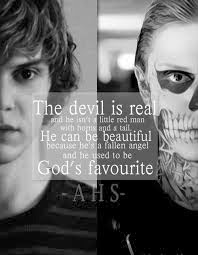
But do enough people believe in such things anymore to make a ghost story viable in the world of entertainment, especially when the program turns its attention directly to the Book of Revelations and the Anti-Christ after just a few episodes? It turns out that the answer is yes if you adapt the ghosts and the Devil to fit modern tastes.

Mental Problems Are for Ghosts, Too

The story is centered around a psychiatrist and his family, which is threatened with division like so many other families in this country. There are many predictable ways in which this family resembles other American families. The threats to its unity are also recognizable for the most part.

However, this television show is striking because the ghosts that plague the family are not simply good or evil. They have mental problems. They suffer from depression and memories blocked by trauma. They see therapists and even take anti-depressants.

The Other Side Looks A Lot Like This Side

The most striking aspects of the show all have to do with the way that modern American culture is reflected. However, all shows naturally do this, except perhaps for those that try to depict prior periods of history.

American Horror Story stands out, in particular, because even its ghosts are much like the rest of us. They are married, they are gay, they are bereaved, they take prescription drugs, they go to the beach and they even have sex occasionally. Most notably, they seem just as confused as the rest of us living souls about what life and death mean.

Saturday, March 2, 2013

The Founding Fathers and the Welfare State

The Founding Fathers of the United States have been depicted in several different lights throughout history. Never at any one time has there been agreement about their composite or specific character. You can find disagreement over the qualities of these men in literature as early as Irving’s Rip Van Winkle, in which the protagonist mistakes a portrait of General Washington for that of King George III.

Modern Misconceptions about the Founding Fathers

Misconceptions abound about these men and their views. In Christian-right circles, these men are sometimes depicted as stalwart and anachronistically fundamentalist Christians. Leftists like Howard Zinn see them as one step removed from robber barons. Others assume that they were secretly anti-slavery because they want to respect these men but can’t get over their glaring possession of black-skinned human beings.

The most popular misconception about them regards their purpose in the War for Independence. Many people think that they were rebelling against monarchy. These men actually appealed to the king to save them from the pseudo-democratic Parliament.

Like any body of men, each of them was a complex being. As a whole, they were also complex. Some wanted to separate themselves from monarchy and create a libertine society that probably would have differed only a little from that which would be erected in France in the next few decades. Others were unabashed monarchists who simply wanted to move up the political food chain in their locale. At the Constitutional Convention in 1787, years after the War for Independence had ended, Alexander Hamilton argued publicly for the institution of an elected monarchy.

The Cultural Difference

There was one quality of all those men, and the other people who occupied the newly-developed country, that was undeniably common. Each of them was self-sufficient. This aspect of their collective character is often trumpeted by so-called conservatives.

It is an undeniable fact. Virtually all people were, when compared to the average person today, self-sufficient. Even the large landowners, such as Washington and Jefferson, had to engage daily in their business affairs in order to keep things going. The only ones that truly lived off the labor of others and idled away their lives were the increasingly useless nobles of Europe and they were far away.

While a pseudo-libertarian like me might adhere to this idea and proclaim a gospel calling for a return to this self-sufficiency, it would be disingenuous. After all, self-sufficiency was not a choice. While it might have been character-building, it undoubtedly also involved a lot of tragedy.

People were self-sufficient because they had to be. It remains in doubt whether they would have been philosophically against a welfare state like our own or the kind seen in Europe today. There are certainly some Founding Fathers who would have been repelled by the state of things today. There is not a consensus among those cadavers about the issue, though.

Moving Forward

Nevertheless, we are not what they were. Most Americans, even the red-blooded kind that still go to Church on Sunday and stand for the pledge of allegiance, believe in some kind of welfare state that is clearly distinct from the early Republic. You can only cut so many social programs before even the most libertarian amongst us cries out in pain.

Perhaps the best way forward is not to look back at these complex men who inhabit a region of the space-time continuum which we cannot ever access. Some have surrendered to the present and simply await the inevitable downfall of a society which constantly spends more than it earns. They still face the same problem that pro-welfare individuals will face when it all comes apart. Each of these people will have to come together again to create the next state. That political organization will have to be derived from the human resources of the present and not from the spiritual remains of the Founding Fathers.